
Why IT Planning Is Now More Important Than IT Support for Growing Businesses in Dubai
Why IT Planning Is Now More Important Than IT Support for Growing Businesses in Dubai
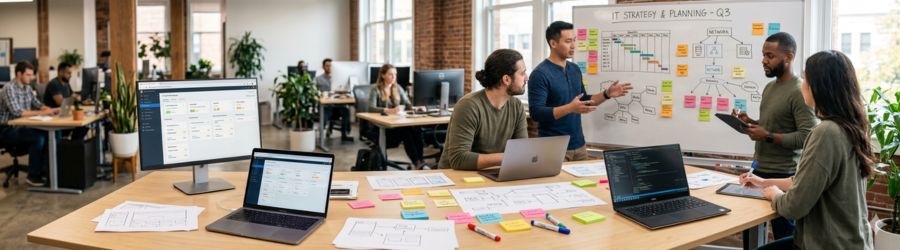
The way businesses use technology in Dubai has changed dramatically over the past few years, shifting from basic system maintenance to long-term digital planning. Instead of only reacting to IT issues as they arise, organizations are now prioritizing structured growth strategies, which is why IT planning services in Dubai are becoming a core part of modern business operations.
As companies expand, the demand for IT strategy consulting in Dubai has increased significantly, helping organizations align their technology investments with long-term business objectives rather than short-term fixes. This shift reflects a growing awareness that technology decisions must be proactive, not reactive.
Many businesses are also beginning to understand why IT support is not enough for business growth, especially when operational demands increase and systems become more complex. While IT support plays a critical role in maintaining day-to-day operations, it does not provide the strategic direction required for scaling infrastructure or driving digital transformation.
To address this gap, organizations are increasingly investing in Professional IT advisory services that help them design structured IT roadmaps, optimize resources, and prepare for future growth. Alongside this, the role of IT consulting in business growth has become more prominent, as companies rely on expert guidance to make informed technology decisions that directly impact performance and scalability.
When analyzing why planning is becoming more important than support, it becomes clear that modern businesses require a shift from reactive problem-solving to proactive strategic IT management.
The Shift from IT Support to Strategic IT Thinking
Traditionally, IT departments were primarily focused on troubleshooting, system maintenance, and resolving technical issues. While these functions are still important, they are no longer sufficient for growing businesses.
Today’s digital environment demands forward-thinking IT strategies that align with business goals such as expansion, automation, cloud adoption, and cybersecurity readiness.
IT support ensures systems run smoothly on a daily basis, but IT planning ensures those systems are designed to scale, adapt, and evolve over time.
This shift marks a fundamental change in how businesses view technology—not just as a support function, but as a core driver of business growth.
“Talk is cheap. Show me the code.”
— Linus TorvaldsWhy Reactive IT Support Is No Longer Enough
Many organizations still rely heavily on reactive IT support models, where issues are addressed only after they occur. While this approach may work for small-scale operations, it becomes inefficient as businesses grow, which is why more companies are shifting toward IT planning services in Dubai to take a proactive approach instead.
Reactive support leads to repeated downtime, inconsistent performance, and increased operational disruptions. It also fails to address underlying infrastructure weaknesses that continue to cause recurring problems.
As businesses expand, relying only on support creates limitations in scalability, security, and performance optimization.
This is why companies are moving toward proactive IT planning models that prevent issues rather than simply responding to them.
The Importance of Long-Term IT Strategy in Business Growth
A strong IT strategy is essential for businesses that want to scale efficiently. Without proper planning, technology investments can become fragmented, inefficient, and costly.
Strategic IT planning ensures that all systems—hardware, software, cloud, and network infrastructure—are aligned with long-term business objectives.
It also helps organizations prioritize investments, reduce unnecessary costs, and improve overall operational efficiency.
More importantly, it ensures that businesses are prepared for future technological changes and market demands.
How IT Planning Improves Scalability and Performance
Scalability is one of the most important factors in modern business environments. As companies grow, their IT systems must be able to handle increased workloads without performance issues.
IT planning ensures that infrastructure is designed with scalability in mind from the beginning.
This includes selecting the right cloud architecture, optimizing network design, and ensuring sufficient storage and processing capacity.
Proper planning also improves system performance by eliminating inefficiencies and reducing bottlenecks before they impact operations.
Security Considerations in IT Planning
Cybersecurity is no longer an optional aspect of IT management—it is a core requirement.
Without proper planning, businesses may implement fragmented security systems that leave gaps in protection.
IT planning integrates security into the foundation of infrastructure design, ensuring that all systems are protected from the beginning.
This includes access control, data protection strategies, network security design, and compliance requirements.
A planned approach significantly reduces the risk of cyber threats and data breaches.
Cost Optimization Through Strategic IT Planning
One of the biggest advantages of IT planning is cost optimization.
Without a clear strategy, businesses often overspend on unnecessary tools, redundant systems, or inefficient infrastructure.
IT planning helps organizations allocate resources more effectively by identifying what is truly needed for current and future operations.
It also prevents costly emergency fixes by reducing system failures and improving infrastructure stability.
Over time, this leads to significant cost savings and better return on IT investments.
The Role of IT Consulting in Business Transformation
Modern businesses are increasingly relying on expert guidance to navigate complex IT environments.
IT consultants provide valuable insights into infrastructure design, system optimization, cloud migration, and digital transformation strategies.
They help businesses avoid common mistakes and ensure that technology decisions align with long-term goals.
This advisory role is becoming increasingly important as IT environments become more complex and interconnected.
Moving from Maintenance to Innovation
Traditional IT support models focus heavily on maintenance and problem resolution.
However, growing businesses need more than maintenance—they need innovation.
IT planning enables organizations to adopt new technologies such as automation, artificial intelligence, and cloud computing in a structured way.
This allows businesses to innovate faster while maintaining stability and control over their IT environments.
Challenges of Ignoring IT Planning
Businesses that focus only on IT support often face long-term challenges such as system inefficiencies, high operational costs, and scalability limitations.
Without proper planning, IT systems can become outdated quickly, requiring frequent upgrades and expensive fixes.
Lack of strategic direction also leads to inconsistent technology adoption across departments, creating integration issues.
These challenges highlight the importance of adopting a structured IT planning approach early in the business lifecycle.
Technology Updates and Continuous Improvement
Keeping IT systems up to date is essential for maintaining performance and security. However, internal teams often struggle to manage regular updates and upgrades due to resource limitations.
Outsourced IT providers handle software updates, system upgrades, and infrastructure improvements as part of their service model.
This ensures that businesses always operate on modern, secure, and optimized systems.
Continuous improvement also enhances system performance and reduces long-term technical debt.
Long-Term Strategic Value of IT Outsourcing
IT outsourcing is not just a short-term cost-saving measure—it is a long-term strategic investment.
By partnering with external IT experts, businesses gain access to innovation, scalability, and advanced technical capabilities that support long-term growth.
This approach allows organizations to stay competitive in a rapidly evolving digital landscape.
Outsourcing also enables businesses to adapt quickly to new technologies and market changes without major internal disruptions.
Future of IT Management in Growing Enterprises
The future of IT management is shifting toward predictive, automated, and strategy-driven models.
Instead of reacting to issues, businesses will increasingly rely on data-driven insights to prevent problems before they occur.
Artificial intelligence and automation will play a key role in optimizing infrastructure, managing workloads, and improving decision-making.
This evolution will make IT planning even more critical for business success.
Final Thoughts — A Strategic Perspective on IT Growth
Technology has become deeply embedded in how modern businesses operate, influencing everything from decision-making to customer experience. As organizations grow, success increasingly depends on how well their IT systems are structured, planned, and aligned with long-term goals, rather than just how well they are maintained on a daily basis.
A shift in mindset is required—from fixing problems as they occur to designing systems that prevent those problems from happening in the first place.
In this evolving landscape, IT planning services in Dubai act as the foundation for building resilient, scalable, and future-ready organizations.
Businesses that prioritize planning over reactive support are better positioned to innovate, adapt, and sustain long-term growth in an increasingly competitive digital economy.